On This Page
Immediate medical evaluation is appropriate when a child has serious warning signs such as significant difficulty breathing, blue or grey lips or skin, seizure or loss of consciousness, unusual unresponsiveness, severe dehydration, severe allergic reaction with breathing difficulty or swelling, major injury, or sudden rapid deterioration. Parents should not wait for symptoms to resolve at home when a child appears seriously unwell. Emergency decisions depend on the child's age, symptoms, medical history and overall condition. When in doubt, seek immediate emergency medical care rather than delaying.
This article provides general health information and is not a substitute for emergency medical assessment. If a child has severe symptoms, is unconscious, is having significant difficulty breathing, has a seizure, or appears seriously unwell, seek immediate emergency medical care.
- Serious breathing difficulty can be an emergency.
- Blue, grey or unusually pale lips/skin can indicate a serious problem.
- Seizures, loss of consciousness or unusual unresponsiveness require urgent assessment.
- Severe dehydration can become dangerous, particularly in younger children.
- Severe allergic reactions can progress quickly and require immediate attention.
- Major injuries and suspected poisoning require prompt medical evaluation.
- When a child appears seriously unwell or deteriorates rapidly, parents should seek emergency care rather than waiting at home.
Introduction
Children can become seriously unwell quickly, and parents often find it difficult to tell the difference between a common childhood illness, a condition that needs a pediatric consultation, and a genuine emergency. A mild cough, a low-grade fever or a minor fall may only require monitoring at home. The same symptoms in a very young infant, or in a child who is not breathing normally or is unusually drowsy, may need immediate emergency care.
Emergency warning signs in children usually involve one or more of these areas: breathing, consciousness, circulation and skin colour, hydration, seizures, severe allergic reactions, major injuries, or sudden deterioration. Recognising these signs early — and knowing what to do — can make a meaningful difference in an emergency situation.
This guide is educational and does not replace professional medical assessment. It is written to help parents act confidently and promptly when something serious is happening. Parents looking for related context on childhood illness can also read our guide on common childhood illnesses, and our article on child vaccination covers preventive care more broadly.
The 7 Pediatric Emergency Warning Signs
The seven warning signs below are situations in which parents should seek immediate emergency medical attention for their child. Each one includes what parents may notice, why it can be concerning, and what action to take.
Severe Difficulty Breathing
Breathing difficulty in a child can range from mild congestion to a serious emergency. Parents should pay close attention when breathing looks different from usual.
What parents may notice
- Struggling to breathe or working hard to breathe
- Very fast or laboured breathing
- Chest pulling in with each breath (retractions)
- Grunting or severe wheezing
- Noisy breathing that is different from usual
- Difficulty speaking or crying because of breathing difficulty
- Child becoming exhausted or unusually sleepy from the effort of breathing
- Blue or grey discoloration around the lips or skin
Significant breathing difficulty requires immediate emergency medical attention. Do not wait to see if it improves at home.
Blue, Grey or Unusually Pale Skin or Lips
Significant colour changes in a child's skin or lips can indicate a serious problem, especially when associated with other warning signs.
What parents may notice
- Blue or grey colour around the lips, tongue or face
- Unusually pale or mottled skin
- Colour changes associated with breathing difficulty
- Colour changes after collapse or unresponsiveness
- Colour changes in a child who appears seriously unwell
Seek immediate emergency medical care. Context matters — a child who has been playing in cold water may briefly look different, but a child with persistent colour change who appears unwell needs urgent assessment.
Seizure, Loss of Consciousness or Unusual Unresponsiveness
Seizures and loss of consciousness require urgent medical evaluation, especially when they occur for the first time or last longer than expected.
What parents may notice
- A first-time seizure
- Ongoing seizure activity
- Repeated seizures
- Loss of consciousness
- Extreme difficulty waking the child
- Sudden unusual unresponsiveness
Basic safety during a seizure
- Keep the child in a safe area away from hard objects
- Protect the head from injury
- Do not put anything into the child's mouth
- Do not try to forcibly restrain movements
- Once movements stop, place the child in a recovery position if they are breathing normally and it is safe to do so
Seek emergency medical help immediately. Do not delay to see if the child improves on their own.
Severe Dehydration or Inability to Keep Fluids Down
Infants and young children can become dehydrated more quickly than adults. Recognising the signs of severe dehydration is important.
What parents may notice
- Very little or no urination
- A very dry mouth
- No tears when crying
- Marked weakness
- Unusual sleepiness
- Sunken appearance around the eyes in some children
- Repeated vomiting or inability to keep fluids down
- Rapid deterioration
Seek urgent medical evaluation when dehydration appears severe or the child cannot maintain fluid intake. Do not attempt to manage severe dehydration at home.
Severe Allergic Reaction
A severe allergic reaction (anaphylaxis) can progress very quickly and requires immediate medical attention.
What parents may notice
- Difficulty breathing
- Swelling of the lips, tongue or throat
- Widespread hives with breathing or circulation symptoms
- Sudden collapse
- Severe dizziness or unusual weakness
- Rapid progression of symptoms
A severe allergic reaction can be an emergency and requires immediate medical attention. If the child has a prescribed emergency device, use it according to their established medical action plan and seek emergency care without delay.
Serious Injury or Head Injury
Serious injuries — particularly head injuries — should be medically assessed promptly, even if the child initially appears fine.
What parents may notice after an injury
- Loss of consciousness at the time of injury
- Repeated vomiting
- Seizure after the injury
- Increasing confusion
- Unusual sleepiness or difficulty waking
- Severe or worsening headache
- Significant bleeding
- Breathing problems
- Severe neck or back pain
- Major trauma
- Abnormal behaviour after the injury
Seek urgent medical assessment. A child who appears fine immediately after a significant injury can deteriorate later — parents should not assume the injury is harmless based only on the child's initial appearance.
Suspected Poisoning or Sudden Severe Deterioration
Suspected poisoning
Potential sources of poisoning in the home may include medicines, household chemicals, cleaning products, unknown substances and potentially toxic plants or substances.
Do not induce vomiting unless specifically instructed by an appropriate medical professional or poison-control service. Do not attempt home detoxification methods.
If possible, take the substance or its packaging to the emergency facility to help identify what was ingested.
Sudden severe deterioration
Also seek urgent medical evaluation if a child rapidly becomes much more unwell, unusually weak, confused, difficult to wake, or otherwise significantly different from normal.
Seek immediate medical or poison-control guidance for suspected poisoning, and urgent evaluation for any child who deteriorates suddenly.
Emergency Symptoms vs Symptoms That Usually Need a Pediatrician
Not every symptom requires an emergency visit. The table below contrasts situations that can often be monitored or discussed with a pediatrician against situations that require emergency care.
| Situation | Typical Next Step |
|---|---|
| Mild runny nose, child active and drinking | Monitor and routine pediatric advice if needed |
| Persistent fever or worsening symptoms | Contact pediatrician |
| Ongoing ear pain | Pediatric evaluation |
| Mild rash without concerning symptoms | Pediatric advice depending on symptoms |
| Significant breathing difficulty | Immediate emergency care |
| Blue/grey lips or skin | Immediate emergency care |
| Seizure or loss of consciousness | Immediate emergency care |
| Severe dehydration | Urgent / emergency medical assessment |
| Severe allergic reaction | Immediate emergency care |
| Major injury | Urgent / emergency assessment |
| Suspected poisoning | Immediate medical / poison-control guidance |
This table is a general educational guide and does not replace professional medical assessment. If you are concerned about your child, contact a healthcare professional.
What Should Parents Do During a Pediatric Emergency?
When a child shows serious warning signs, quick and clear action matters. The following steps outline what parents should generally do.
Recognise the warning sign
Serious symptoms should not be ignored. Trust your instinct — if your child appears seriously unwell, act on it.
Seek emergency medical help
Use your local emergency medical service or proceed to an appropriate emergency facility depending on the situation. Do not delay.
Keep the child safe
Take basic safety measures appropriate to the situation — for example, protecting the head during a seizure, or not moving a child with a suspected neck injury.
Do not delay for unnecessary home remedies
Do not spend time trying experimental treatments or remedies when the child needs professional care.
Take important medical information
If it does not delay care, bring the following:
- Current medicines
- Allergies
- Medical records
- Vaccination record when relevant
- Recent medical reports
Do not delay emergency care just to collect documents.
What Should Parents NOT Do During a Child Emergency?
A few common mistakes can worsen an emergency situation. Knowing what to avoid can help you focus on what matters most.
- Do not wait too long when serious warning signs are present.
- Do not give unknown medicines.
- Do not force food or fluids when the child is unconscious or unable to swallow safely.
- Do not put anything into the mouth during a seizure.
- Do not induce vomiting after suspected poisoning unless specifically instructed.
- Do not leave a seriously unwell child alone.
- Do not rely solely on internet or social media advice during an emergency.
When Should Parents Call an Ambulance or Emergency Service?
Emergency medical services can provide urgent care before reaching the hospital and can transport a child safely. Parents should consider calling an ambulance when:
- The child is not breathing normally
- There is severe breathing difficulty
- The child is unconscious
- The child has a serious seizure
- There are signs of severe allergic reaction
- The child has suffered major trauma
- The child is rapidly deteriorating
- Immediate transport or medical support is required
If you are unsure whether to call an ambulance, err on the side of caution and contact emergency medical services or an appropriate emergency facility. Do not wait to see if the child improves on their own.
Pediatric Emergencies in Babies and Infants
Babies and infants may show serious illness differently from older children. Because they can become unwell more quickly and cannot describe how they feel, parents should pay close attention to changes from their baby's normal behaviour.
Breathing changes
Fast, laboured, noisy or irregular breathing, or pauses in breathing.
Poor feeding
Refusing feeds, feeding much less than usual, or being unable to feed.
Unusual sleepiness
Sleeping much more than usual or being hard to wake for feeds.
Difficulty waking
Not responding to usual stimuli, or being unusually floppy or stiff.
Reduced urination
Fewer wet nappies than usual, which may indicate dehydration.
Colour changes
Pale, mottled, blue or grey skin, or jaundice that is worsening.
Persistent vomiting
Vomiting that continues or is forceful, especially if green or bloody.
Seizures
Any seizure activity, unusual jerking or stiffening, or unresponsiveness.
Fever concerns
Very young infants may need earlier assessment for fever — seek advice promptly.
Very young infants can require earlier medical assessment for certain symptoms. Parents should not wait to see if a newborn improves on their own — seek advice from a healthcare professional promptly.
What Information Should Parents Tell the Emergency Team?
When you reach emergency care, the following information helps the team assess your child quickly and appropriately.
- Child's age
- Main symptoms
- When symptoms started
- How symptoms changed
- Existing medical conditions
- Allergies
- Current medicines
- Recent illness
- Recent injury
- Possible ingestion or exposure
- Vaccination history when relevant
- Any treatment already given
Do not delay emergency care while gathering information. Share what you know — the emergency team can work with partial information and ask further questions.
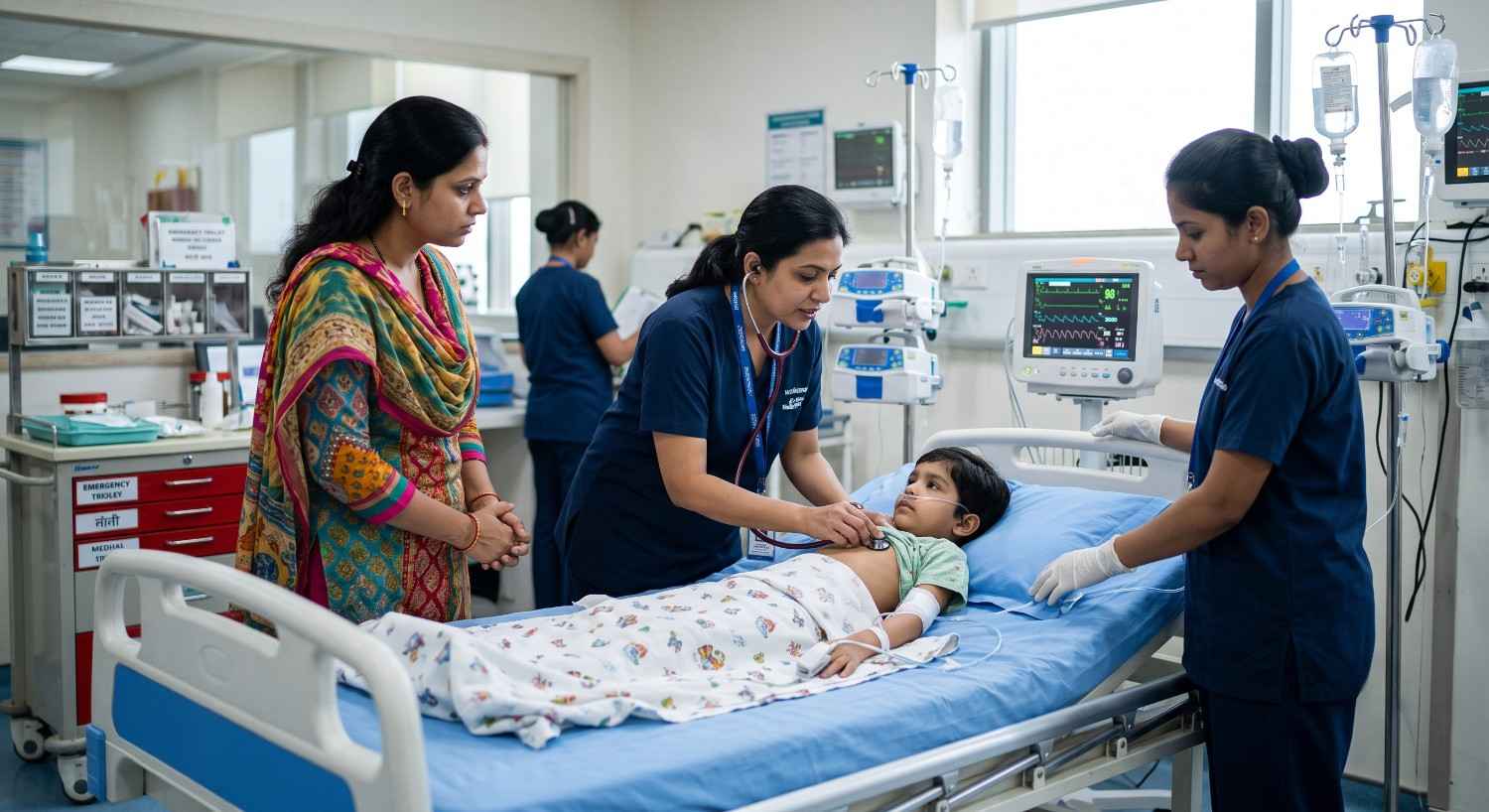
What Happens After a Child Reaches Emergency Care?
Emergency care for a child typically follows a structured approach. Not every child will need every step — the exact process depends on the situation.
Initial assessment
A rapid review of the child's condition to identify any immediate concerns.
Vital signs
Measurement of temperature, heart rate, breathing rate and oxygen levels.
Breathing and circulation assessment
Focused assessment of airway, breathing and circulation.
Consciousness assessment
Checking the child's alertness and responsiveness.
Immediate stabilisation when necessary
Oxygen, fluids or other supportive measures as needed.
Focused examination
A more detailed examination based on the child's symptoms and presentation.
Tests when clinically indicated
Blood tests, imaging or other investigations may be appropriate for some children.
Treatment based on findings
Treatment is guided by the assessment — it may include observation, supportive care or medication.
Observation or admission when necessary
Some children are observed in the emergency department; others may need admission for continued care.
Discharge and follow-up when appropriate
If the child is stable, discharge may be possible with clear follow-up instructions.
Not every emergency results in hospital admission. Many children are assessed, treated and discharged with follow-up guidance. Parents should not assume that a visit to emergency care will always lead to admission — the priority is making sure the child is safe.
Pediatric Emergency Care in Tirunelveli
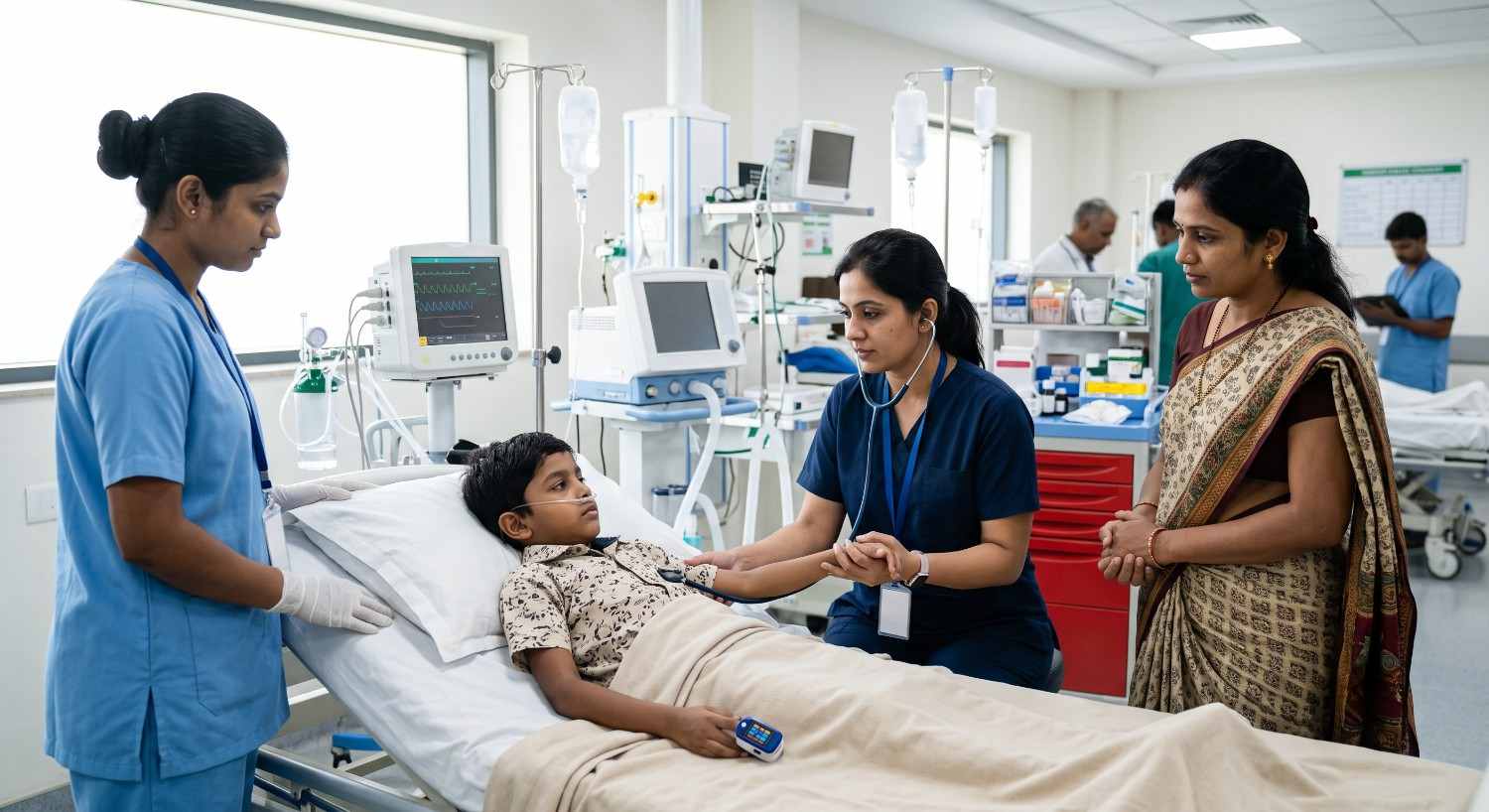
Parents in Tirunelveli can seek pediatric emergency care at hospitals that provide emergency medical support for children. When identifying an appropriate emergency facility, families may consider several practical factors.
Availability of emergency medical support
Access to 24/7 emergency medical services for children.
Pediatric-trained healthcare professionals
Staff with experience in assessing and treating acutely unwell children.
Ability to assess acutely unwell children
Facilities equipped to evaluate seriously unwell children promptly.
Access to diagnostic services
Laboratory and imaging services when clinically appropriate.
Pediatric monitoring facilities
Ability to monitor a child's condition while assessment and treatment are underway.
Emergency stabilisation capability
Capacity to stabilise a child's condition before transfer or admission.
Referral pathways
Clear pathways when specialised care or transfer is required.
Clear communication with parents
Transparent communication about the child's condition and next steps.
Parents can identify the nearest appropriate emergency facility in advance, confirm how to reach it, and keep important medical information ready. Krishna Hospital offers pediatric services and emergency support for families in Tirunelveli — parents can review the hospital's pediatric services or contact the hospital team for more information. For related context on childhood illnesses and preventive care, parents may also find our articles on common childhood illnesses and child vaccination useful.
How Can Parents Prepare for a Pediatric Emergency?
Preparation can reduce delays and stress during a pediatric emergency. The following items are useful to have ready in advance.
- Important medical records
- Vaccination records
- Current medication list
- Allergy information
- Pediatrician contact information
- Emergency contact information
- Basic first-aid supplies
- Knowledge of the nearest appropriate emergency facility
Having this information easily accessible can save valuable time when every minute matters.